
Apple looks set to launch its most expensive phones on September 9 and hold the standard iPhone 18 until spring, which would be a first in eighteen years of iPhone.
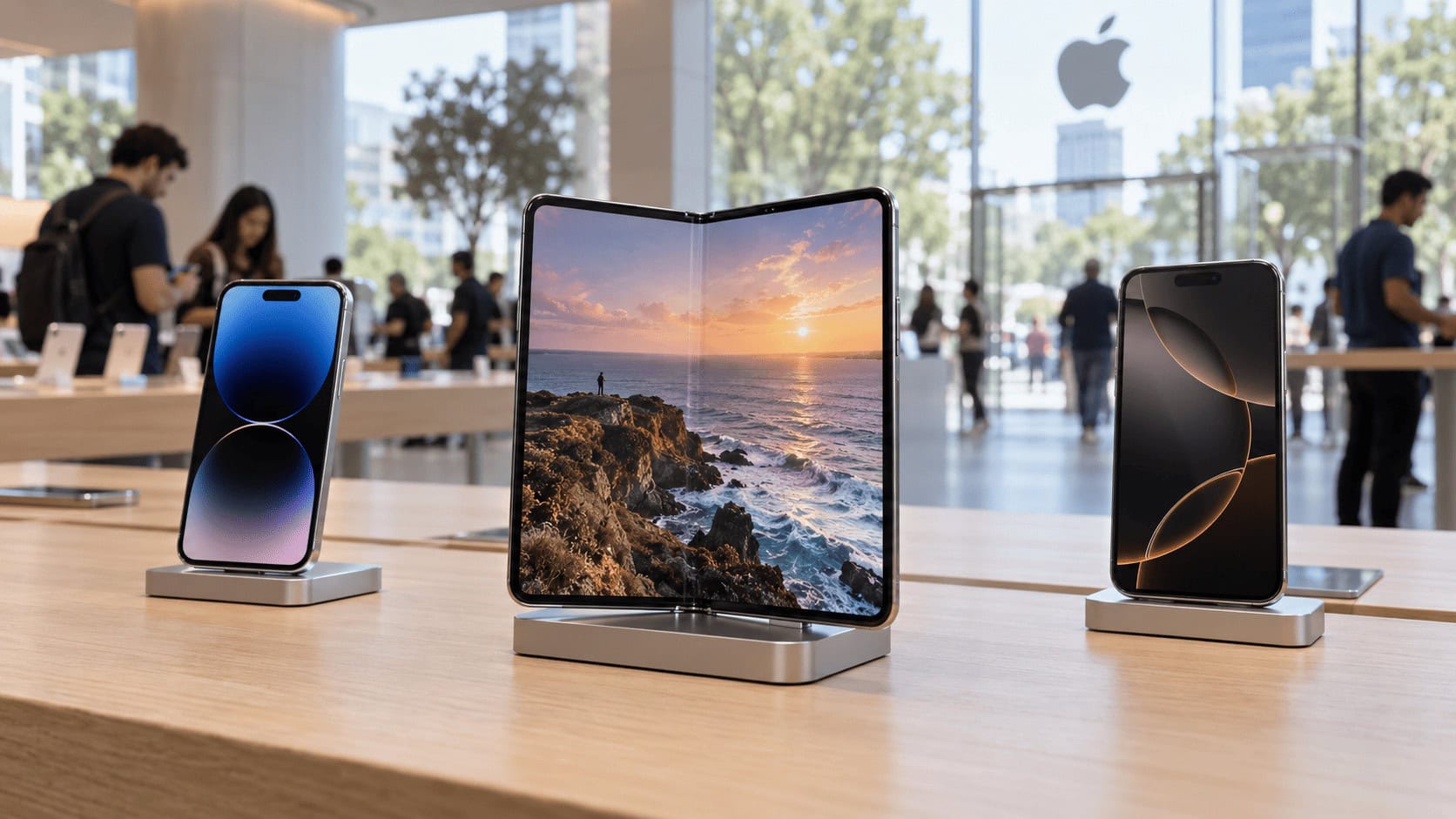
Everyone has already decided what September 9 is about. Apple finally ships a foldable, the iPhone Ultra, reportedly north of $2,000, more than five years after Samsung got there first. Cue the crease jokes.
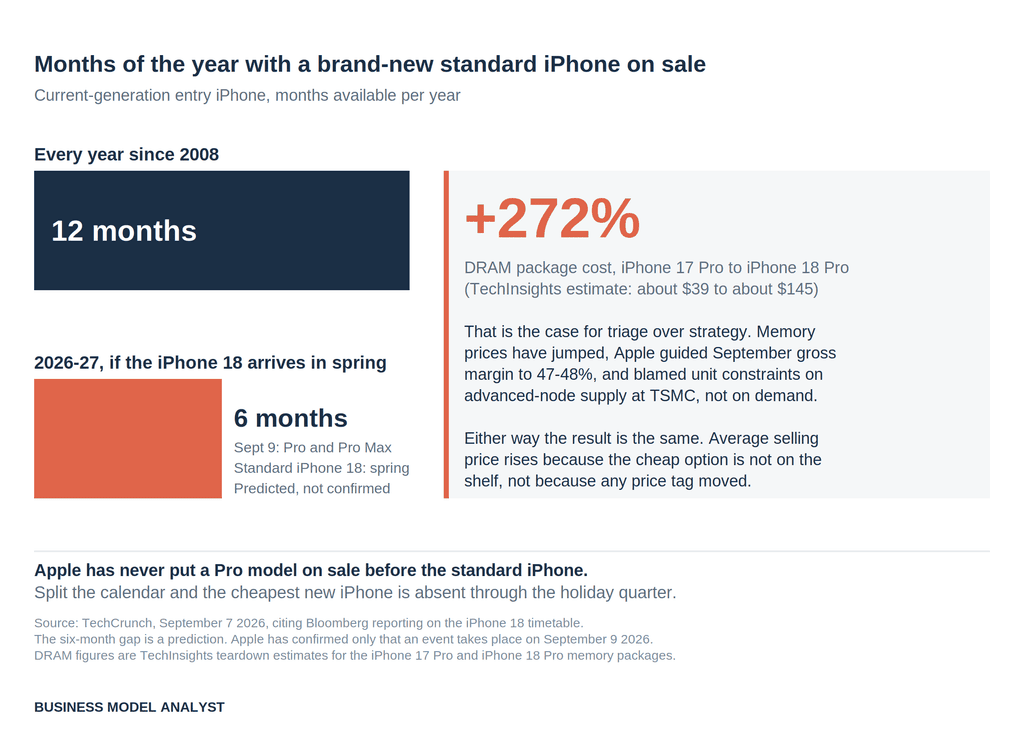
Fine. But scroll to the bottom of the rumor pile and there is a stranger line. TechCrunch notes the iPhone 18 Pro and Pro Max are expected next week, while the standard iPhone 18 is predicted to arrive roughly six months later. Apple has never done that.
Read it again. For two quarters, including the holiday one, the cheapest brand-new iPhone on the shelf would be a Pro.
A New Top Rung, Built From Fewer Parts
Start with the Ultra, because the spec sheet is doing something unusual. Per Bloomberg’s Mark Gurman and the leak pile TechCrunch assembled:
- 5.5-inch cover display, opening to 7.8 inches
- No telephoto camera, just a main and ultra-wide pair, the same setup as Apple’s cheaper phones
- No Face ID, replaced by a side-mounted Touch ID button to save space
- MagSafe stays, and it runs iOS rather than iPadOS
- The same chip reportedly found in the budget MacBook Neo
So Apple is asking for roughly double the money for a device that is, on two visible axes, less phone. What you are buying is the hinge. That is a striking thing for a company whose whole business model rests on premium hardware justified by premium components.
It is also a real bet. Apple priced a shape once before with the $3,500 Vision Pro, and the world shrugged. The difference this time is that everyone already owns a phone, so the Ultra is not asking anyone to adopt a new category, only to pay more inside an old one. IDC expects Apple to take about 40% of the foldable market by the end of 2027, which tells you how little competition matters here.
The Ultra is not a camera upgrade. It is a price tier wearing a hinge.
The First Time the Expensive One Ships First
Now the calendar. Apple raised prices across Mac, iPad, Apple TV, HomePod and Vision Pro in June, and pointedly left iPhone prices alone. The iPhone is the volume franchise and the one consumers price-check hardest.
So if you cannot raise the iPhone’s sticker, you raise the mix. Removing the entry model from the shelf through the September and December quarters does exactly that. An upgrader in November has three choices: pay up for a Pro, buy a discounted older model, or wait until March. Two of those are good for Apple, and one of them is very good.
This is differentiation strategy running at the product-line level rather than the product level, which is where Apple’s generic competitive strategy has always done its quietest work. The company did not need a new feature to move average selling price. It just needed to change what is in stock, and its target market is famously bad at waiting.
For context, Apple did $109.4 billion in its June quarter and guided the September quarter to 9% to 11% growth, down from 16%. A mix lever that costs nothing to pull looks a lot more attractive against that number.
Steelman: Maybe This Is Triage, Not Strategy
Here is the honest counterargument, and it is strong. This might not be clever at all.
Memory prices have gone vertical. TechInsights pegged the DRAM package in the iPhone 18 Pro at about $145, against roughly $39 in the 17 Pro, which is the same squeeze behind Apple’s mid-cycle price hikes earlier this year. Apple guided September gross margin to 47% to 48% and blamed unit constraints on advanced-node availability at TSMC, not on demand.
Under that reading, the six-month gap is not a pricing strategy. It is Apple building the units it can actually build, in the order that protects margin, and pushing its highest-volume, thinnest-margin model into a window where memory contracts might have cooled. Every die goes to the device that can absorb its cost. It also fits a company whose supplier commitments have quietly gone short-dated, leaving it less insulated from a component shock than its reputation suggests.
The tell is that both readings end in the same place: average selling price up, entry point gone. Elegant strategy and desperate triage look identical from the outside. They just feel different in the room where it was decided.
The Business Model Angle
Scarcity of the cheap option is a pricing lever. You do not need to raise a price to raise revenue per unit. You can remove the floor and let the mix do the work. Any business with a good-better-best ladder has this lever, and almost nobody pulls it deliberately.
The sensor is moving to the body without a new category. Apple appears to be building AirPods with cameras, spotted in a macOS preview build. Gurman reports the cameras act as eyes for Siri, capturing low-resolution visual information rather than photos. Apple’s smart glasses have reportedly slipped toward 2027. Shipping the sensor on a product with an existing attach rate is faster and cheaper than convincing anyone to wear a new thing on their face. Ask Meta about the second path.
Staggered launches are becoming a playbook. One event, one demand pulse, one inventory build is a nineteenth-century retail rhythm. Splitting a flagship across two windows smooths component ordering, gives you two press cycles, and lets you reprice the cheap version after you have seen what the expensive one sold for.
The Takeaway
The foldable will get the headlines and it deserves some of them. But the more consequential move at this event is subtraction. John Ternus’s first launch as CEO may quietly establish that for half of every year, there is no cheap new iPhone. Apple spent two decades making the entry model good enough that most people never left it. Making it late is the first serious test of what that habit is actually worth.