
An AI shopping agent is an ad blocker with a credit card. Which retailers let it in depends on whether they get paid at the register or in the aisle.
Retailers are splitting into camps over AI shopping agents, and the split is not about technology, trust or taste. It tracks where each company collects its money. A store that earns on the order wants a robot customer. A store that earns on the visit cannot afford one, because the robot buys the product and skips the shelf where the visit gets monetized.
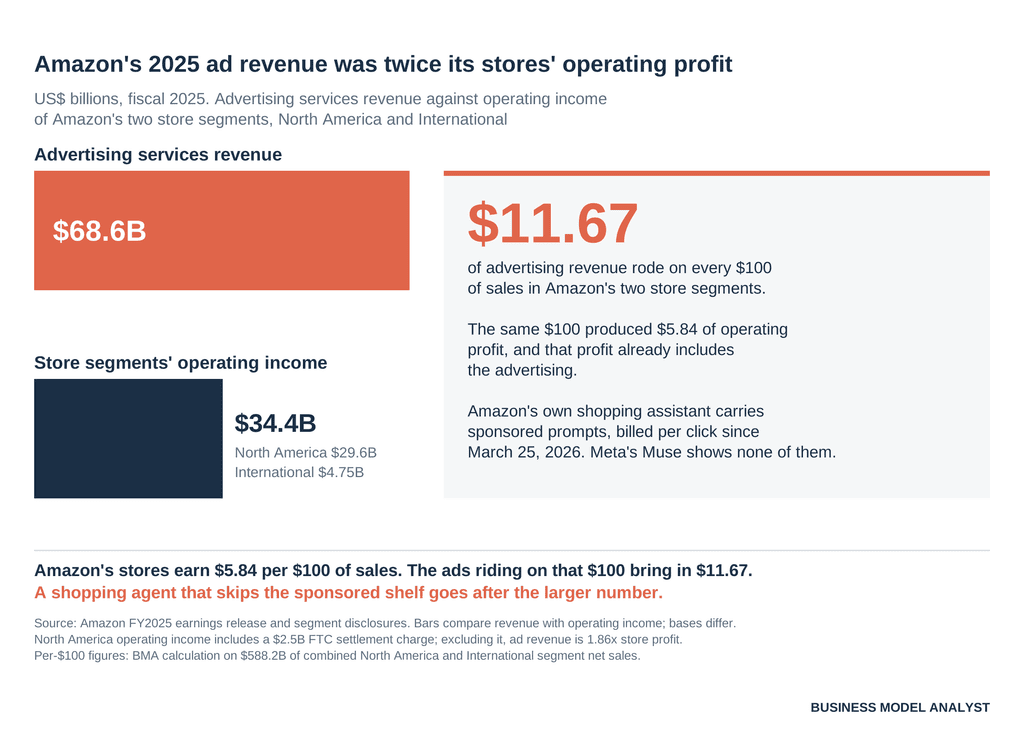
Amazon is the clearest case. In 2025 it booked $68.6 billion of advertising revenue. Its two store segments, North America and International, produced $34.4 billion of operating profit combined. The ads brought in twice what the stores earned.
So when Meta’s new Muse agent started shopping on Amazon.com in September, Amazon did not see a shopper. It saw a customer who would never look at a sponsored listing, sent by the second-largest ad seller on earth, which has said it plans to charge merchants a fee on every purchase.
Amazon shut the door twelve days after Muse launched. Here is what the rest of retail’s door policies reveal about their business models, and why “browse but don’t buy” is the most interesting answer of all.
What Happened
The Wall Street Journal surveyed how retailers are handling agentic commerce, the idea that AI agents will browse, compare and buy without a human clicking through, and found a spectrum rather than a consensus.
At one end sit QVC and HSN. They let agents complete purchases and push their catalogs to OpenAI and Google for visibility. David Thompson, QVC Group’s senior vice president of product and technology strategy, put the logic simply: “We need to be out in the places that already are grabbing her attention.” He also admitted QVC cannot yet confirm whether any agent has actually bought anything, and that some may be tripping its older anti-fraud systems.
In the middle sits Gap, which decides case by case which agents may browse and which may check out. Then comes Tapestry, parent of Coach and Kate Spade, which lets agents browse its sites but not buy, citing fraud and inventory hoarding, where bots fill carts and never pay. Tapestry is still rebuilding checkout so agents can use it later, if it changes its mind.
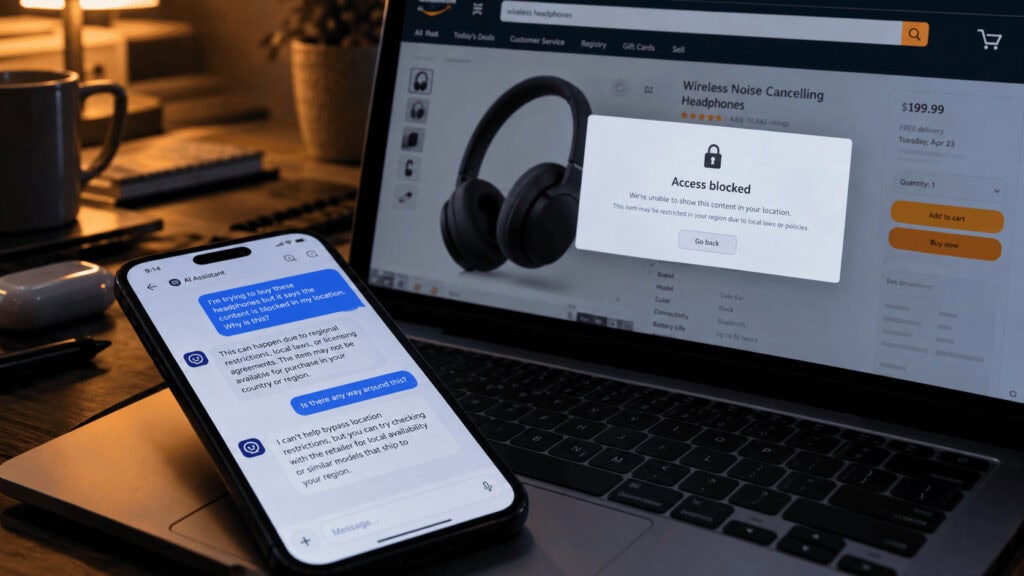
Further along, Kohl’s blocks agentic purchases outright. Chewy and Neiman Marcus block certain agents, according to verification firm Billions Network. And at the far end sits Amazon, which blocks agents from OpenAI, Google, Anthropic and Perplexity, per the same research, and on September 20 began blocking Meta’s Muse. Users who tried to shop Amazon through Muse got a popup saying an unauthorized AI agent violated Amazon’s Conditions of Use.
Muse launched September 8. At Meta Connect on September 23, Meta announced shopping integrations with Walmart, Best Buy, Gap, Sephora and others, and Shopify said Muse could buy from every merchant on its platform. Meta says Muse generates a one-time card number per transaction and asks permission before it buys.
The demand side is thin. Only 3% of US adults would trust an agent to complete a purchase, per a survey by payments firm NMI, and a third of active AI users told VML they would never let an agent buy or even reorder for them. Andy Jassy told investors last year that the agent shopping experience was not good yet, because AI fumbles prices and basic product details.
Investors did not wait. Meta stock was up more than 29% for September heading into the final days of the month, on course for its best month since 2013, and travel names including Airbnb, Expedia and TripAdvisor fell around 5% in the week Meta expanded Muse.
The Backstory
Amazon has been fighting this war for a year, and it already lost the first battle.
In November 2025 it sued Perplexity over Comet, a browser whose built-in assistant shops Amazon for its users. A district court granted Amazon a preliminary injunction in March 2026. On August 4, a unanimous Ninth Circuit panel vacated it, holding that when an AI tool acts on a shopper’s instructions, it is the shopper, not the tool’s maker, who accesses Amazon’s computers under federal hacking law.
The court left one door open: it said it was not limiting Amazon’s ability to set rules through its own terms of service. That is exactly the door Amazon walked through with Muse. The popup does not cite the hacking statute. It cites the Conditions of Use that every customer has already accepted.
eBay took the same route earlier. A User Agreement update posted January 20 and effective February 20 banned “buy-for-me agents, LLM-driven bots” and any end-to-end ordering flow without human review, unless eBay grants permission.
Here is the part that undercuts the idea that Amazon simply dislikes robots. Amazon runs agents of its own. Its shopping assistant, Rufus, renamed Alexa for Shopping in May 2026, carries Sponsored Products and Sponsored Brands prompts inside its answers, billed per click since March 25, 2026. And Amazon’s Buy for Me feature does to other retailers precisely what Muse tried to do to Amazon: it completes checkout on brands’ own websites from inside the Amazon app. CNBC reported in January that some small merchants discovered their catalogs listed through Buy for Me without having opted in.
Amazon’s own statement on Muse said the quiet part almost out loud. It complained that an outside agent bypasses the personalization Amazon has built, so shoppers may see products not drawn from Amazon’s recommendation engine. The recommendation engine is where the sponsored slots live.
Amazon is not against shopping agents. It is against shopping agents that do not carry its shelf.
The Plan
Line the retailers up by where their toll sits, and the door policies stop looking like a debate and start looking like accounting.
Toll on the visit: lock the door. Amazon’s advertising line is built on a human scrolling past sponsored results. Every $100 of sales in its two store segments in 2025 carried $11.67 of advertising revenue and produced $5.84 of operating profit, and that profit figure already includes the ads. An agent that reads the catalog, picks the best match and checks out never sees the sponsored row. It keeps the sale and deletes the impression.
Toll on the transaction: hold the door open. Shopify made $8.8 billion of its $11.6 billion in 2025 revenue from merchant solutions, mostly payment processing, on $378.4 billion of gross merchandise volume. That is about $2.33 for every $100 its merchants sell, and Shopify collects it whether a person or a bot pressed the button. An agent checking out through Shop Pay is just more GMV. No wonder Shopify opened its entire merchant base to Muse.
Toll on reach: roll out the welcome mat. QVC Group filed for Chapter 11 on April 16, 2026, and a bankruptcy court approved a plan in July cutting its debt from $6.6 billion to about $1.33 billion. First-quarter revenue fell 7% to $1.96 billion as linear TV audiences kept shrinking. A business whose problem is that its customer stopped watching does not worry about which screen she uses next. It sends the catalog to every agent it can find.
Toll on scarcity: browse, but don’t buy. Tapestry’s answer looks like a compromise and is actually the most precise of the four. Browsing is free marketing. Checkout is allocation. Coach’s model leans on a handful of icon bag families and limited drops, and hoarding inventory is what bots do to anything scarce. A machine that can add to cart in milliseconds turns a drop into a race the brand no longer controls. Letting agents look while keeping the register human protects the one thing a scarcity model sells.
Walmart, Best Buy and Gap sit in the open camp for a related reason. They are chasing Amazon, and an agent that lands shoppers on their shelves is distribution they do not have to buy. Walmart runs a real advertising business, about $6.4 billion last year, but that is less than a tenth of Amazon’s. When the visit is worth less than the reach, the door opens.
The Business Model Angle
An agent is an ad blocker with a credit card. Retail media works because a shopper with buying intent scrolls past paid placements on the way to the product. An agent compresses that scroll to nothing. Sponsored Products alone is widely estimated by the trade at around two thirds of Amazon’s ad revenue, roughly $47 billion, which on its own is still about 1.4 times the store segments’ 2025 profit. That is the line exposed, and it is why Amazon was willing to fight the same battle twice in a year. The auction behind those placements is already under FTC scrutiny; an agent threatens the inventory the auction sells.
Meta is not asking for access. It is asking for a cut. Mark Zuckerberg told developers at Connect that Muse will stay free for heavy use “with the expectation that over time we will profit by taking a small fee from transactions.” Reporting since then says the fee comes from merchants, and Meta has not said how large it is. For a Shopify brand that already buys Instagram ads, that fee just moves acquisition cost from a CPM line to a per-order line. For Amazon, it means losing the sponsored shelf and then paying the company that competes for the same brand ad budgets for the privilege. The fight is less agent versus store than Meta’s ad business versus Amazon’s.
The door policy is a disclosure. Nobody is shopping with agents in volume yet, so blocking or welcoming them costs almost nothing in sales today. That makes each stance unusually honest. It tells you what a company thinks a visit is worth beyond the order, a number almost no retailer publishes. It is the same logic as the captcha economy: once checking who is at the door gets cheap, the door becomes a pricing decision.
The Risk
The security case is not a cover story, and it deserves full weight. Amazon says Muse did not identify itself as automated and captured and stored customer login credentials. An agent operating inside a logged-in session is exactly the attack surface fraud teams lose sleep over, and Amazon’s position that agents should operate openly and let merchants opt out is defensible on its own terms. Tapestry’s fraud worry is the same worry, held by a company with no advertising business at all.
Walmart complicates the neat version of the thesis. It has a growing ad business and still joined Muse. The honest reading is that ad dependence is relative, not binary: Walmart’s ads are a small slice of a much larger store, and its strategic problem is share, not shelf. A model that predicts every retailer’s stance from one variable would be too clean to trust.
The arithmetic also compares unlike things. Ad revenue is not ad profit, and the store segments’ profit already contains the ads. The comparison shows how much of the system’s economics ride on a human looking at a page. It does not say Amazon’s stores lose money without advertising, which would depend on an ad margin Amazon does not disclose.
And the toll could simply move. Amazon may yet decide to charge agents for admission rather than ban them, the way infrastructure companies have started pricing crawler access, or to license access only to agents that render its sponsored results. Its own assistant already carries paid prompts. If that is the endgame, the block is a negotiating position.
The falsification test is clean. If Amazon signs an access deal with an outside agent that shows no sponsored placements and pays no fee, the visit-toll thesis is wrong. If the first deal it signs includes paid placement inside the agent or a per-order payment to Amazon, it is confirmed.
Quick Questions
Why did Amazon block Meta’s Muse? Amazon says Muse did not identify itself, captured customer logins, and bypassed its personalization. The economic backdrop is a $68.6 billion advertising business that depends on shoppers seeing sponsored results.
Can Muse still shop at Walmart, Best Buy or Gap? Yes. All three announced integrations with Muse at Meta Connect on September 23, and Shopify opened its merchants to it.
Didn’t Amazon lose in court over this? It lost its injunction against Perplexity’s Comet on August 4, when the Ninth Circuit ruled that the user, not the agent maker, accesses the site. The court left terms-of-service enforcement open, and that is what Amazon is now relying on.
Does Amazon have its own shopping agent? Yes. Alexa for Shopping, formerly Rufus, carries paid Sponsored Products prompts, and Buy for Me completes purchases on other brands’ websites.
How many people actually let AI buy for them? Very few so far. An NMI survey found only 3% of US adults would trust an agent to complete a purchase.
How will Meta make money from Muse? Zuckerberg says Meta will eventually take a small fee from transactions Muse completes, reportedly charged to merchants. The rate has not been disclosed.
The Business Model Analyst Take
Every store has two products: the thing on the shelf and the shopper standing in front of it. For most of retail history the second one was free. Amazon turned it into a business larger than the first, and that is the whole reason a robot customer is a threat rather than a gift.
The rule worth keeping is short. A store that earns more from your attention than from your purchase will never let a robot shop for you on someone else’s terms. It will build its own robot and put the ads inside. Amazon already has.
That makes the agent fight less about AI than about who gets to stand between the shopper and the shelf. Meta wants that spot and has said it will charge rent for it. Amazon owns that spot today and is using its business model to defend it. Shopify does not care who stands there, because it gets paid at the register either way.
For founders, the useful version is a single question to ask before betting on agent traffic: where does your toll sit? If you earn on the order, agents are a free channel and you should be first in line. If you earn on the visit, agents are a pricing problem, and the time to decide what an automated visitor owes you is before they arrive, not after. The same reasoning is reshaping media, where bots already outnumber people and the attention economy is learning to bill machines.
Retail spent twenty years teaching shoppers to scroll. The next twenty will be spent finding out who gets paid when they stop.