

Amex raised Gold and Platinum by roughly the same 30%. The only thing that actually grew was the gap between them.
The Wall Street Journal reports a new credit card category forming just below the ultra-luxe tier: cards in the $325 to $395 range, aimed at younger Americans who want the lounge and the dinner credits without the $895 bill. Ted Rossman of Money Management International calls it the “upper-middle-class option.”
It is a tidy story. Run the fee history, though, and the new tier looks less like a new category and more like a ruler that got stretched evenly from both ends.
The middle did not get cheaper. The top got expensive enough to make the middle feel like a bargain.
The 36% Rule Nobody Announced
American Express raised the Gold card from $250 to $325 in July 2024. It raised Platinum from $695 to $895 in September 2025. Two refreshes, fourteen months apart, nearly identical percentages:
- Amex Gold: $250 to $325 (+30%)
- Amex Platinum: $695 to $895 (+29%)
- Chase Sapphire Reserve: $550 to $795 (+45%)
Before the hikes, Gold cost 36.0% of Platinum. After them, 36.3%. A rounding error.
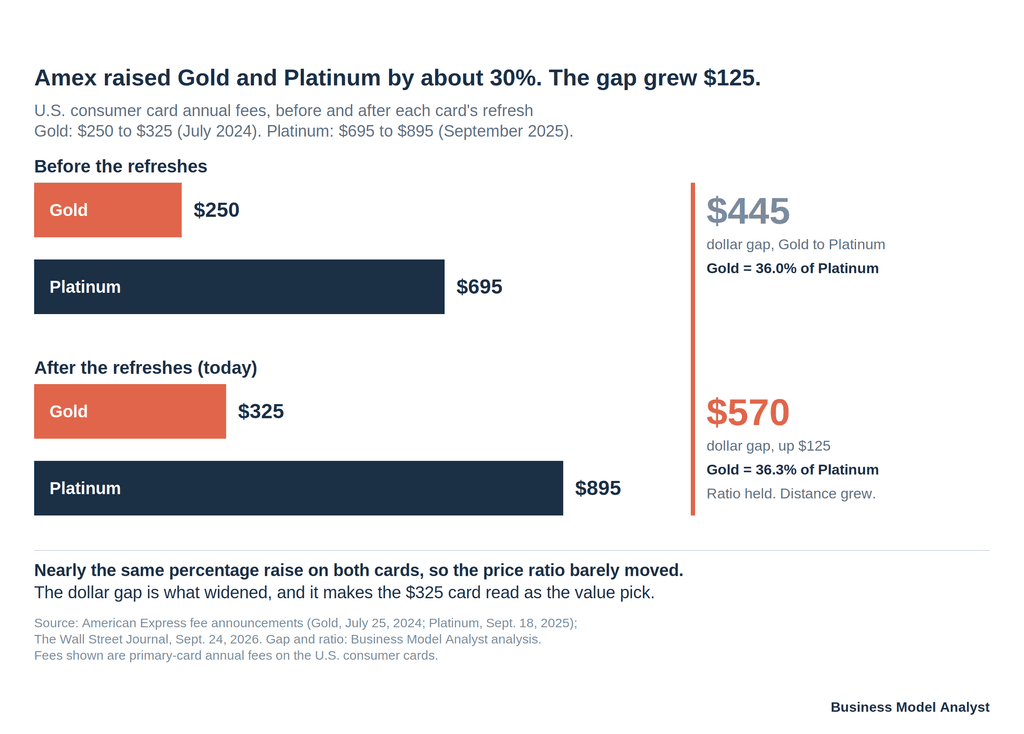
What changed is the dollar distance. The gap between Gold and Platinum went from $445 to $570, and shoppers compare dollars, not ratios. That is exactly the math the Journal’s lead character ran. Skye Zhao, a 25-year-old doctoral student in New York, could not justify $895 but decided $325 was worth it. She did not trade down. She landed on the rung Amex built for her.
That is not a new category. That is a decoy doing its job.
Today’s Middle Is 2016’s Top
Chase launched the Sapphire Reserve in August 2016 at $450. Now line up the cards the Journal files under near-premium:
- Amex Gold: $325
- Citi and American Airlines co-brand: $350
- Capital One Venture X: $395
- Alaska Atmos Rewards Summit: $395
Every one sits below the 2016 flagship in plain nominal dollars. Adjust for inflation and the gap widens: Totavi’s Matthew Goldman put that original $450 at about $602 in 2025 money. Meanwhile the Reserve itself climbed 77% in nine years.
So the “almost-premium” card costs roughly what premium cost a decade ago, and about a third less in real terms. Premium did not split into two tiers. It moved upstairs and left its old price behind with a new label on the door.
The Counter-Case: Cheaper Is Not Easier
Rossman’s warning deserves a real hearing: the perks on these cards often fail to cover the fee, and many people would do better with a no-fee card. The numbers back him up in a way the fee alone hides.
The Gold card’s four recurring credits (Uber Cash $120, dining $120, Resy $100, Dunkin’ $84) add up to $424. To break even on credits alone, you have to capture 76.7% of them. The Platinum needs just 29.9%, per our ranking of what premium card perks are actually worth. The cheaper card sets the harder test, and most of its credits reset monthly.
Heavy users still win big. Katie Suiters, the Journal’s second cardholder, visited Capital One lounges at least 10 times this summer. That works out to $39.50 per visit on a $395 fee, less than the $45 Capital One charges an adult guest to walk through the same door. Near-premium pays off for people whose habits already match the merchant list. For everyone else, it is a monthly chore with a pretty card attached.
The Business Model Angle
Price the ratio, harvest the gap. If you raise the flagship, raise the middle by the same percentage. The ratio stays put, the dollar gap widens, and a “value” tier appears on its own. You get the positioning of a new product without building one.
Make the entry tier a funnel that pays for itself. Amex says Gold holders average 29 years old against 33 for Platinum, roughly a four-year on-ramp, and CFO Christophe Le Caillec calls Gold Gen Z’s “favorite product.” In Q2 2026, Millennials and Gen Z were 65% of American Express‘s new consumer accounts, 75% of new accounts carried a fee, and net card fees hit $2.86 billion, up 15%. Charging a fee at the entry rung means customer acquisition turns profitable long before anyone upgrades.
Price for the second slot, not the first. Alaska’s loyalty chief told the Journal most consumers will not carry two $800-to-$900 cards. So airline co-brands at $350 to $395 are designed to sit next to a Platinum or a Reserve, not replace it. A Platinum plus an Atmos Summit costs $1,290 a year, and nobody has to choose. Southwest and Chase are next with a higher-end card in 2027, and Southwest is already pouring millions into lounges to sell it.
Quick Questions
What counts as an almost-premium credit card? The Journal’s examples all charge $325 to $395 a year: the Amex Gold at $325, the Citi and American Airlines co-brand at $350, and the Capital One Venture X and Alaska Atmos Rewards Summit at $395 each. They offer a slice of the luxury tier, such as lounge access or dining credits, at well under half the $795 to $895 that the Sapphire Reserve and Platinum now charge.
Is the Amex Gold card worth the $325 fee? Only if its credits land on spending you already do. The four recurring credits total $424, so you need to use about 77% of them to cover the fee on credits alone. The bigger draw for heavy food spenders is the earn rate: 4x points at restaurants worldwide (up to $50,000 a year) and at U.S. supermarkets (up to $25,000).
Why did Amex raise both the Gold and Platinum fees? Each hike came with a benefits refresh. Gold went from $250 to $325 in July 2024 alongside new Resy and Dunkin’ credits. Platinum went from $695 to $895 in September 2025, with Amex claiming more than $3,500 in stated annual value. The fees are paying off for Amex: net card fees reached $2.86 billion in Q2 2026, up 15% from a year earlier.
How is the Venture X different from the Amex Gold? They do different jobs. The Venture X is built around travel: Capital One lounges, a $300 annual credit for bookings through Capital One Travel and 10,000 anniversary miles. Since February 2026, though, guests at Capital One lounges cost $45 per adult unless the account spends $75,000 a year. The Gold is built around food, with its credits and bonus points concentrated on restaurants, delivery and groceries.
The Takeaway
The almost-premium card is not a sign that rich-card pricing went too far. It is proof that the ladder works. Issuers lifted every rung together, let the distance between rungs do the persuading, and turned a 25-year-old’s “I can’t justify $895” into a $325 yes. The smartest price hike in consumer finance is the one that makes its own cheaper sibling look generous.