
The fund buys credibility. The annual city ranking buys leverage, and Airbnb asked Brussels to make that leverage matter five days before announcing it.
Airbnb committed $250 million in last-dollar financing to stalled housing projects, starting with $6.4 million for 201 affordable units in Austin. The money is real and it is small. Deployed at the Austin rate, it reaches about 1% of the stalled pipeline Airbnb’s own commissioned research identified. The three things announced alongside it cost far less and last far longer: money for local pro-housing advocacy groups, a construction technology prize, and an annual worldwide index scoring cities on their housing policies. The last one is the asset.
For fifteen years the housing argument has run against Airbnb. Cities said listings tied up apartments, tenants said the same thing louder, and roughly 60,000 illegal listings in New York in 2018 became about 3,000 registered ones by 2025. The company’s answer was always some version of the same point: the listing counts are too small to move rents.
On September 14, Airbnb stopped making that argument alone and started funding the other one. It is putting $250 million into housing construction, hiring a former White House housing-policy official to run it, and preparing to publish a global ranking of how well cities do at building homes.
The fund is what got the headlines. It is the least interesting part.
What Happened
Airbnb launched the Airbnb Housing Accelerator with four pillars.
The first is capital. An initial $250 million goes into “last-dollar” financing for rental developments that are entitled, designed and stuck for want of a final tranche. Airbnb says the returns will run significantly below market rates, that it will prioritize affordable and mixed-income projects, and that recycling the money should unlock more than $5 billion of total capital over ten years. Developers apply through Airbnb’s site.
The second is advocacy. Airbnb is funding local organizations pushing zoning, permitting and building-code reform, naming the Citizens’ Housing and Planning Association in Massachusetts, the Florida Housing Coalition, AURA in Austin and the Housing Action Coalition, plus research with the Chicago Urban League. Airbnb describes the footprint as communities where 100 million Americans live.
The third is the Airbnb City Index, due later this year: an annual ranking of cities worldwide on housing additions per capita, affordability measures, and the rules that help or block production, published for journalists, researchers, advocates and policymakers.
The fourth is a $5 million Housing Innovation Prize, five awards of $1 million for construction technology. Airbnb’s own footnote says eligibility and program details come later and may change.
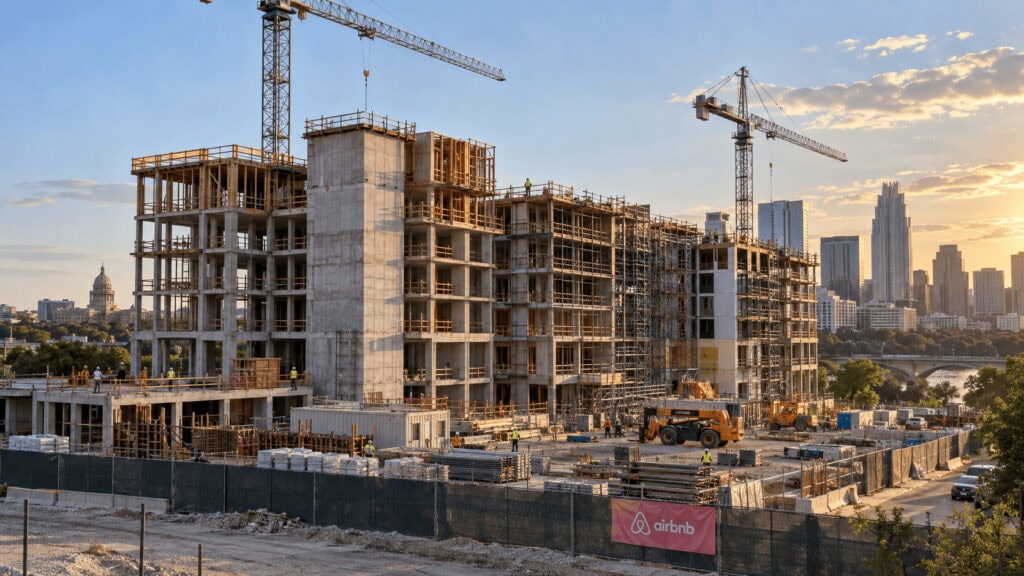
The first deal is $6.4 million for 201 affordable units at 800 E. St. John Avenue in Austin. The city has owned the site since 2013 and it has sat empty for close to two decades. Under an agreement with Austin, the fully affordable 201 units had to happen before a companion 325-unit mixed-income building could be built, and Greystar’s project stalled five years for lack of money even with state affordable-housing incentives attached. Residents of the affordable units will not be allowed to list them for short-term rental.
The Backstory: Airbnb Already Ran This Pilot
Nobody covering this has mentioned that Airbnb did a smaller version seven years ago and it went quiet.
On September 17, 2019, Airbnb announced a $25 million Community Impact Investing program for the San Francisco Bay Area and Los Angeles County, aimed at affordable homeownership, affordable and workforce rental housing, infrastructure and small business. Brian Chesky announced it on stage with California’s governor. He called it a modest first step and said he expected the program to expand.
Look at how that money was structured. It was handed to RBC Global Asset Management to run as a fixed-income strategy. Airbnb wrote a check, a bond manager allocated it, and Airbnb had no deal-level involvement, no policy arm, no data product and no staff. That is treasury management with a press release stapled to it.
The 2026 version is a different species. Same company, same subject, ten times the money, and every structural choice inverted. The capital is deployed deal by deal rather than through an asset manager. It has a named director in Daniel Hornung, who was Deputy Assistant to the President and Deputy Director of the National Economic Council, where he oversaw housing policy and led the policy work behind the federal Housing Supply Action Plan. It has an advocacy budget, a research budget, a prize and an index.
The delta between 2019 and 2026 is not the dollar amount. It is that Airbnb stopped buying an allocation and started building a policy shop.
What $250 Million Actually Buys
Run the arithmetic Airbnb gave you.
The Austin deal is $6.4 million for 201 units, which is $31,841 of Airbnb money per affordable unit. Hornung told the WSJ that Airbnb’s check will generally be about 10% of a project’s capital, which implies roughly $318,000 of total capital per unit and about $64 million for the affordable half of St. John.
At that rate, the full $250 million touches roughly 7,850 units. Airbnb commissioned research putting the stalled national pipeline at 750,000 units that have cleared most regulatory hurdles and lack final financing. So the fund covers about 1% of the problem Airbnb paid to have measured. The $5 billion of unlocked capital Airbnb projects over a decade works out to around 15,700 units, or about 2%.
The ten-year claim is also a recycling claim you can decompose. Ten times leverage on $250 million is $2.5 billion. Getting to $5 billion requires turning the money over exactly once more, which implies an average hold near five years per dollar. That is a long time to sit in construction financing and a short time against the compliance periods that usually govern affordable housing. It is not impossible. It is a schedule, and schedules can be checked.
Now size the fund against the company.
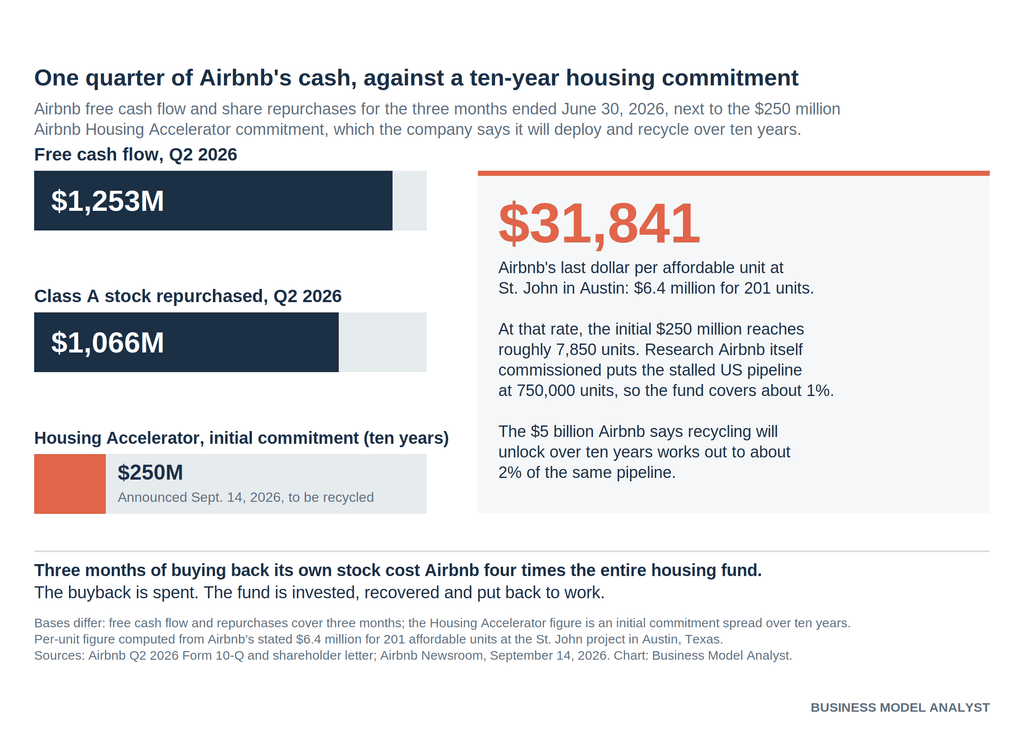
In the second quarter of 2026 alone, Airbnb produced $1.25 billion of free cash flow and spent $1.07 billion buying back its own stock, with $3.4 billion still authorized. Trailing twelve-month free cash flow is $4.8 billion. Cash, equivalents and restricted cash sat at $19.0 billion on June 30. Last year the company earned $2.5 billion on $12.2 billion of revenue.
Three months of buybacks cost four times the entire housing fund. And the comparison flatters the buyback, because a repurchase is spent forever while the housing money is an investment that comes back and gets redeployed. The real annual cost to Airbnb is not $250 million. It is the yield Airbnb gives up by earning below-market returns instead of market ones on about 1.3% of its cash.
This is not an accusation. It is the reason to look elsewhere for the point of the announcement.
The Index Is the Instrument
Five days before the Housing Accelerator launched, Airbnb published its position on the European Union’s Affordable Housing Act. Read the two documents together and the strategy resolves.
In the September 9 post, Airbnb argued that the Act as drafted “will not add a single home to the long term rental market” while leaving hosts exposed to arbitrary local restrictions. It put short-term rentals at 1.2% of EU dwellings against roughly one in five dwellings sitting vacant, cited €149 billion of economic impact and €40 billion of tax revenue, and said the shortage is about construction, renovation and empty homes.
Then it made two specific asks. New short-term rental restrictions should be notified to the European Commission before adoption, with supporting data and an impact assessment. And restrictions already in force should be reviewed against the Act’s own standard of necessity and proportionality.
That is a request for an evidence test on city rules. Five days later, Airbnb announced it will publish the annual global dataset of city housing policies and outcomes.
Whoever publishes the scoreboard defines the objective function. An index that ranks cities on housing additions per capita and on the rules that enable production creates a public metric on which restricting short-term rentals scores at best neutral and building scores well. It gives journalists a citable number, gives advocates a rank to campaign against, and gives a company facing a proportionality review a dataset to file.
The advocacy money works the same way and costs even less. Airbnb’s grant to AURA in Austin lets the group hire its first paid staff member after more than a decade as an all-volunteer operation. One salary buys a permanent professional voice in the city hall that sets the rules a $6.4 million check had to work around. Per dollar, that is the highest-leverage line in the entire announcement.
The Business Model Angle
A standards body is cheaper than a lobbying campaign and lasts longer. Lobbying expires with the bill. An annual index compounds, because year two is measured against year one and the methodology becomes the definition of good policy. Airbnb is buying a recurring publication, not a vote.
Commission the research that sizes the problem your product solves. The 750,000-unit figure did not exist as a standard number before Airbnb paid for it. Now it is the denominator every story about the fund uses, including this one. Defining the metric is upstream of competing on it.
The credential is the cost of entry, not the strategy. Airbnb had no standing to argue about housing supply while it was the accused. $250 million of below-market capital and a completed building in Austin buy the standing. Any regulated platform with a balance sheet can run this play: spend a recoverable amount on the problem you are blamed for, then argue from inside.
Watch where the concession is free. Barring affordable-housing residents from listing costs Airbnb nothing, since rent-restricted units were never viable short-term supply. The concessions that look most generous are often the ones priced at zero, and they are the ones to expect first.
The Risk
Start with the strongest case that Airbnb is simply right.
New York removed the listings. Roughly 60,000 illegal listings in 2018 and more than 38,000 active ones in early 2023 became about 3,000 registered short-term rentals by 2025, a decline north of 90%. Median asking rent still rose about 2.1% in the year after enforcement began, and hotel rates climbed roughly 6% in 2024. If short-term rentals were the binding constraint on New York rents, that is not what the aftermath would look like. The supply argument Airbnb is funding has real evidence behind it, and a credible open dataset on city housing policy does not currently exist. That is a genuine public good even when a self-interested party builds it.
Now the failure mode, which has a precedent with a name.
The World Bank launched Doing Business in 2002 and it became the most influential regulatory ranking in the world, ranking 190 economies and moving real policy. The Bank discontinued it on September 16, 2021 after an external investigation found data irregularities and pressure on staff to change scores. A replacement report did not appear until 2024. The lesson is not that indices are bad. It is that an index becomes worth manipulating in direct proportion to how much it matters, and the manipulation risk sits with whoever controls the methodology.
Airbnb will control the methodology of an index that scores the same cities that regulate Airbnb. No disclosure note fixes that. And unlike the World Bank, Airbnb has no board of member states and no obligation to keep publishing. If a future edition ranks a city well on housing while that city is restricting short-term rentals, or ranks a friendly city badly, Airbnb can quietly stop.
The falsification test is straightforward and arrives within a year. If the City Index publishes its full methodology, weights and underlying data, and if short-term rental policy carries no weight in the score, this reads as infrastructure. If the weights are unpublished or short-term rental rules appear as a scored variable, it reads as an instrument. Watch the first edition.
Quick Questions
Is $250 million a lot for Airbnb? No. It is about 5% of one year of free cash flow, roughly a quarter of a single quarter’s buyback, and it is recoverable rather than spent.
Does the fund actually build housing? Yes. St. John is a real project that was stalled for five years and is now moving, and the 201 affordable units were the condition for 325 more.
Why last-dollar financing specifically? Because it maximizes units per dollar. A small tranche at the end unlocks capital that is already committed, which is why 10% of a project can claim credit for 100% of it.
Is the comparison to other corporate housing funds fair? Only partly. Previous big-tech housing commitments concentrated on the metros where those companies employ people. Airbnb’s exposure is not geographic, it is categorical, which is why the advocacy and index pillars cover cities Airbnb will never fund a building in.
What would make this look better? Publishing the deal pipeline, the realized returns and the index methodology in full, and letting outsiders audit the unit counts.
The Business Model Analyst Take
The cheapest line item in this announcement is the one that changes the most.
$250 million buys 201 apartments in Austin and the right to be taken seriously in a conversation Airbnb has been shouted out of for a decade. One staff salary at a volunteer advocacy group buys a permanent seat in the room where Austin decides what can be built. And an annual index nobody has to read yet buys the thing companies almost never get: the ability to define what good performance looks like for the governments that regulate them.
Airbnb did not build a housing fund. It built a policy department and put a fund on the front of it, which is a very effective place to put a fund.