
Utah licensed a prescribing AI, and the real product is a staircase only the state can let it walk down.
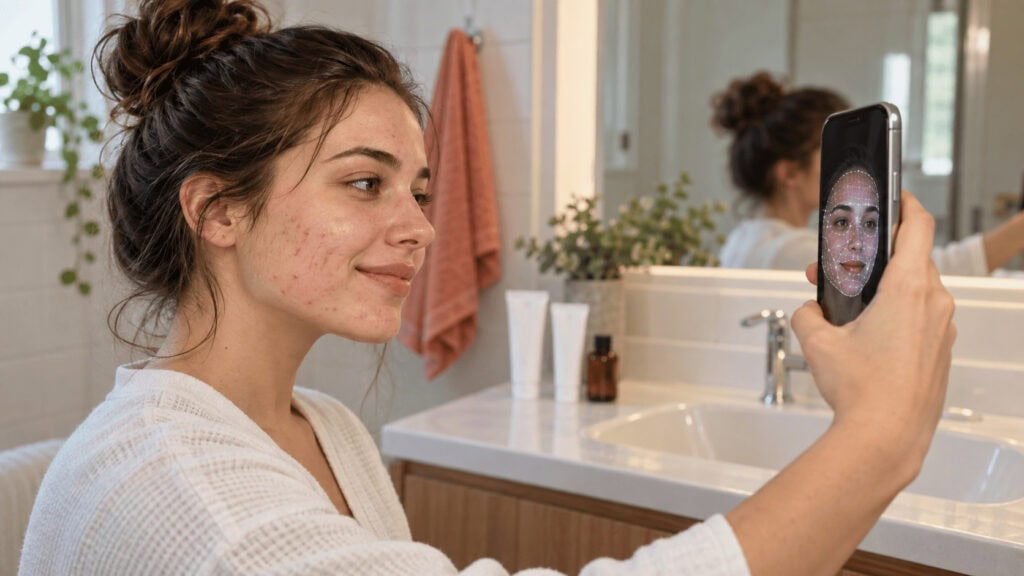
On Monday, Nolla Health opened its Nolla Derm app to Utah adults: scan your face, answer a short intake, get a first-time acne prescription for $4.99 a month. Digital Trends and most of the internet called it the first AI doctor. “Our AI can now make that prescribing decision itself,” CEO Luis Wenus said in his launch video.
Here is what the headlines skipped. For its first 100 patients, every prescription the AI writes must be approved by two Utah-licensed physicians before it ships. On day one, the robot doctor eats more physician time per script than the human-run telehealth apps it wants to replace.
That is not a bug. It is the business model. The number that matters is how fast Nolla can walk physician review down from two per prescription to one in ten.
What Utah Actually Signed
Utah’s Office of Artificial Intelligence Policy and its Division of Professional Licensing signed the deal on September 22. Legally, it is a promise not to prosecute Nolla’s AI for practicing medicine, for one narrow job, and the signed agreement says plainly it is not an endorsement.
- Topical treatments only, for adults with mild to moderate acne
- A fixed formulary: tretinoin, adapalene, clindamycin with benzoyl peroxide, benzoyl peroxide and azelaic acid, plus a few compounded blends
- No pills, no isotretinoin (Accutane), no severe cases. A severity score above 3.5 on a five-point scale goes to a physician, and a 4.0 goes to an in-person dermatologist
The pitch is access. Nolla’s state filing puts the Utah dermatology wait near 61 days, with 11 counties lacking a dermatologist and office visits at $150 to $300.
One detail tells you who still carries the risk: every script goes out under the overseeing physician’s NPI number. The AI makes the call. A human license signs for it.
The Ladder Is the Product
Oversight steps down in three stages, and each step needs written approval from the state:
- Stage one (first 100 patients, at least four weeks): two physicians approve every prescription before it reaches the patient. Two reviews per script.
- Stage two (up to 500 patients, at least eight weeks): the AI ships directly and doctors review every case after the fact, weekly. One review per script.
- Stage three (from 750 patients): doctors audit a monthly sample of at least 10% of volume, plus every adverse event or escalation. Roughly 0.1 reviews per script.
That is a 20-fold drop in physician touches per prescription, and it is where the margin lives. Nolla says its $49.99 compounded medication is a pass-through to its pharmacy partner, with no referral fee. So the subscription (discounted from $9.99) is the revenue line, and physician minutes are the cost line to kill.
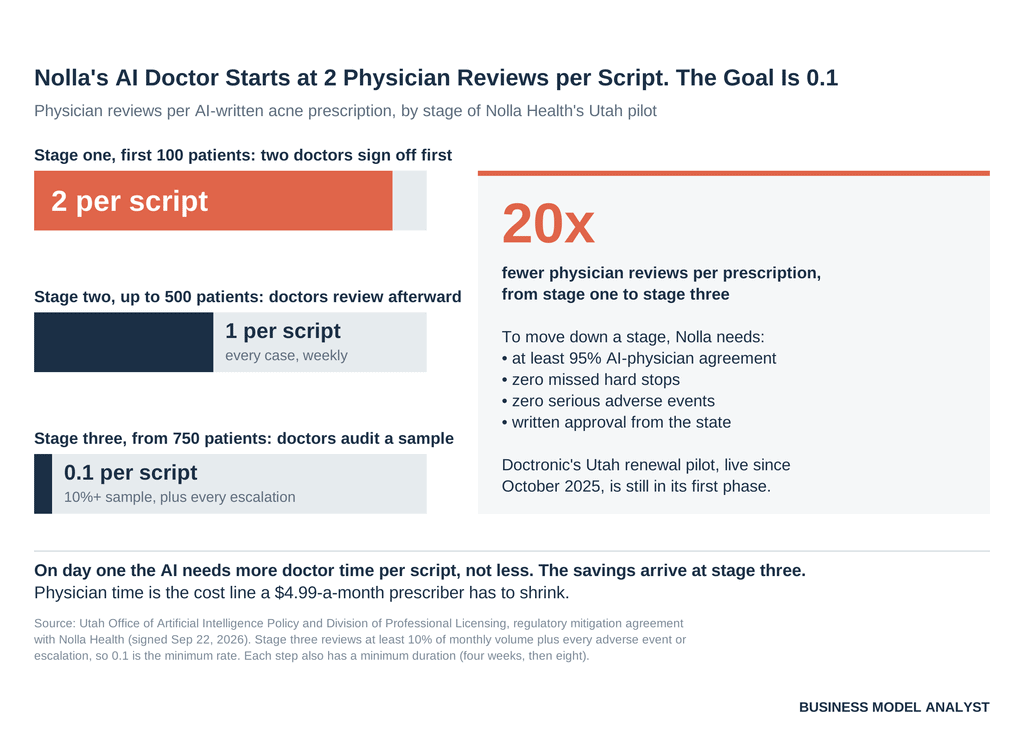
To climb, Nolla needs at least 95% agreement between the AI and reviewing doctors, zero missed hard stops and zero serious adverse events. Its own proposal claims about 96% clinician agreement on its last 1,000 real treatments.
On paper, the bar is already cleared. On paper.
The Precedent Says Stairs Can Stall
Utah has run this movie once. Doctronic got a pilot for AI prescription renewals, announced in January, at $4 per renewal. In April, the Utah Medical Licensing Board asked for its immediate suspension, saying it was never consulted. The state’s record still shows Doctronic in phase one, with a human authorizing every request.
Nolla studied that tape. It went to the licensing board before getting authorized, and Utah’s AI office told Quartz it does not expect a repeat fight. Acne helps too: decades-old generics, with isotretinoin, the drug with real teeth, off the table.
A sharp skeptic adds two points. “First AI doctor” is Nolla’s claim, not Utah’s, and the state’s record listed the demonstration period as not yet started even as the app went live. And the safest drugs prove little about cases where a wrong call is expensive.
Both fair. Both miss what is being tested. Utah is not grading the model. It is grading the ladder.
The Business Model Angle
The moat is the audit trail, not the model. A severity scorer can be copied. A year of state-audited reports and third-party validation cannot. That file is the template for the next state, the exact play Doctronic’s investor Tusk Ventures says it is running in eight more.
Utah is a demo, not a market. Nolla estimates about 100,000 Utahns have active acne at any given time. Sign up every one at $4.99 and you get roughly $6 million a year. The real funnel is the 175,000-plus downloads across 44 states, waiting for their state to copy the paperwork.
The review ratio sets the price floor. Telehealth brands built their subscription model around bundling a clinician’s time into a monthly fee. If an approved AI runs at one physician review per ten scripts, $4.99 stops being a pilot discount and becomes the category’s reference price.
Quick Questions
Can AI prescribe medication in the US? Only in narrow, state-approved pilots. Utah lets Nolla Health’s AI issue first-time prescriptions for topical acne treatment to adults under a sandbox agreement. Outside pilots like this, a licensed clinician still signs every prescription.
How much does Nolla Derm cost? $4.99 a month during the Utah pilot, discounted from a standard $9.99. Medication is extra: $49.99 for home-delivered compounded treatment, or generics that typically run $10 to $40 at a local pharmacy.
What can the AI prescribe? Topical creams and gels for mild to moderate acne only: tretinoin, adapalene, clindamycin with benzoyl peroxide, benzoyl peroxide, azelaic acid and a few compounded blends. Oral drugs and isotretinoin (Accutane) are excluded.
Who can use it? Utah residents 18 and older, verified with a government ID and a selfie, with a Utah delivery address. Pregnancy, breastfeeding, immunosuppression and severe kidney or liver disease stop the process.
Does a doctor check the AI’s prescriptions? Yes, for now. Two physicians approve every prescription for the first 100 patients. Later stages shift to after-the-fact review of every case, then to a monthly sample of at least 10%, and each step needs written approval from the state.
Is the FDA involved? No. The authorization is a 12-month agreement with the State of Utah, extendable twice, and the state says it is not an endorsement of the product.
The Takeaway
Utah did not approve an AI doctor. It approved an AI resident with two attending physicians and a written path to fewer. In August we argued that for wearables, regulatory classification decides who you can invoice. AI prescribing adds a second dial: the regulator also decides how much doctor you have to buy per sale. Watch the ratio fall from 2 to 0.1. Whoever gets there first owns the template for the other 49 states.