
Florida ranks fourth in federal military spending and still trails California on defense startups. The office is an origination channel, and the landlord built it.
Andreessen Horowitz is opening a regional headquarters in West Palm Beach for American Dynamism, a $1.176 billion fund that is the third largest of its four sector funds. Florida’s defense-tech startup count is still small. What Florida has in volume is the buyer.
For fifty years, venture geography followed one rule: put the office where the engineers are. Sand Hill Road exists because Stanford exists. Kendall Square exists because MIT exists. Capital parked itself next to the supply of people who write code.
Defense inverts that. The engineers are portable. The customer is not. Three of the eleven unified combatant commands sit in Florida, alongside 21 major military installations and the launch complexes on the Space Coast, and none of them is relocating to Palo Alto.
So the question worth asking is not whether Florida is a hotbed. It is what a venture firm actually buys when it leases a continent of distance from its own deal flow.
What Happened
Andreessen Horowitz told The Wall Street Journal it will open a regional base in downtown West Palm Beach next year, staffed by a team overseeing its American Dynamism practice.
The fund behind it raised $1.176 billion. It was one slice of a broader raise the firm disclosed on January 9, 2026, totaling more than $15 billion across six vehicles, which a16z said represented over 18% of all venture capital dollars allocated in the United States during 2025. The raise pushed firm assets under management past $90 billion.
The office will sit in CityPlace Tower, a Class AA building owned by Related Ross, the West Palm Beach developer that courted the firm.
Katherine Boyle, the general partner who co-founded the American Dynamism practice, said the region “has become one of the most important places in the country” for the work the fund backs. The firm framed the move as expanding beyond traditional tech hubs to sit closer to where these companies get built.
There is a wrinkle in that framing. This is a16z’s second Florida office. The firm opened in Miami during the crypto cycle and closed it roughly two years later when the local crypto market fell apart. The same firm, the same state, a different thesis.
The Backstory
Florida’s defense position was built by geography and then compounded by decades of mission assignment. It sits at the country’s southern maritime gateway, close to the Caribbean and Latin America, and the headquarters that plan operations across Latin America, the Middle East and global special operations all ended up there.
The scale is real. Florida’s military and defense industry generates $102.6 billion in economic impact and supports more than 865,000 jobs statewide, according to the Florida Defense Industry Economic Impact Analysis cited by the Journal. The state ranks fourth nationally in federal military spending. Florida also put nearly $23 million into strengthening its defense industrial base, and Space Florida, the state’s aerospace finance and spaceport authority, markets what its chief executive called a “suite of unmatched financial tools” that lower the cost of capital through tax treatment.
The launch side compounds it. The Space Coast carries the country’s primary national-security launch complexes, and the commercial operators running them have become large enough to attack adjacent regulated markets, as Starlink is doing to the phone bill. Proximity to a launch range is now a procurement advantage, not a novelty.
Corporate arrivals followed. Palantir, whose government contracting model is about as embedded in federal work as software gets, relocated its global headquarters to Miami. Satellite maker Terran Orbital built a South Florida footprint before Lockheed Martin acquired it in 2024. A geospatial intelligence and counterdrone company, Space-Eyes, is scaling there now. The Pentagon executive who runs its AI efforts lives in Miami.
Here is what the state does not have. The Journal is blunt about it: the number of defense-tech startups based in Florida is still relatively small and trails Northern and Southern California. The category’s flagship names sit elsewhere. Anduril, which turned defense hardware into a software business, builds in Costa Mesa. Chaos Industries is in Los Angeles. SpaceWERX, the Space Force venture arm, has awarded more contracts to California businesses since 2021 than to any other state.
A hotbed of capital is not the same thing as a hotbed of companies. Right now Florida is clearly the first and not yet the second.
The Plan
Strip the announcement down and the asset a16z is buying is access, sold to it by a landlord.
Related Ross owns the tower. It also hosts the Defense Tech Leadership Summit in partnership with AWS and Vanderbilt University, and the Wall Street Journal’s Invest Live conference, both returning to West Palm Beach in early 2027. It is a founding partner of the Florida Council of 100’s accelerator, which runs a dual-use and defense-tech track with eMerge Americas. And it courted the venture firm that just signed the lease.
Vanderbilt is doubling its planned West Palm Beach graduate campus from 1,000 to 2,000 students, adding defense tech and national-security studies framed around space, energy and infrastructure.
Read that as a stack rather than a coincidence. A developer assembled the convening layer, the credentialing layer and the physical layer, then leased the result to the buyer most willing to pay for proximity. The “ecosystem” is a product with an owner, and the tenant is also the amenity that makes the next lease easier to sign.
That is a familiar structure in industrial real estate. It is new in venture.
The Business Model Angle
Start with the arithmetic that the announcement does not put next to itself.
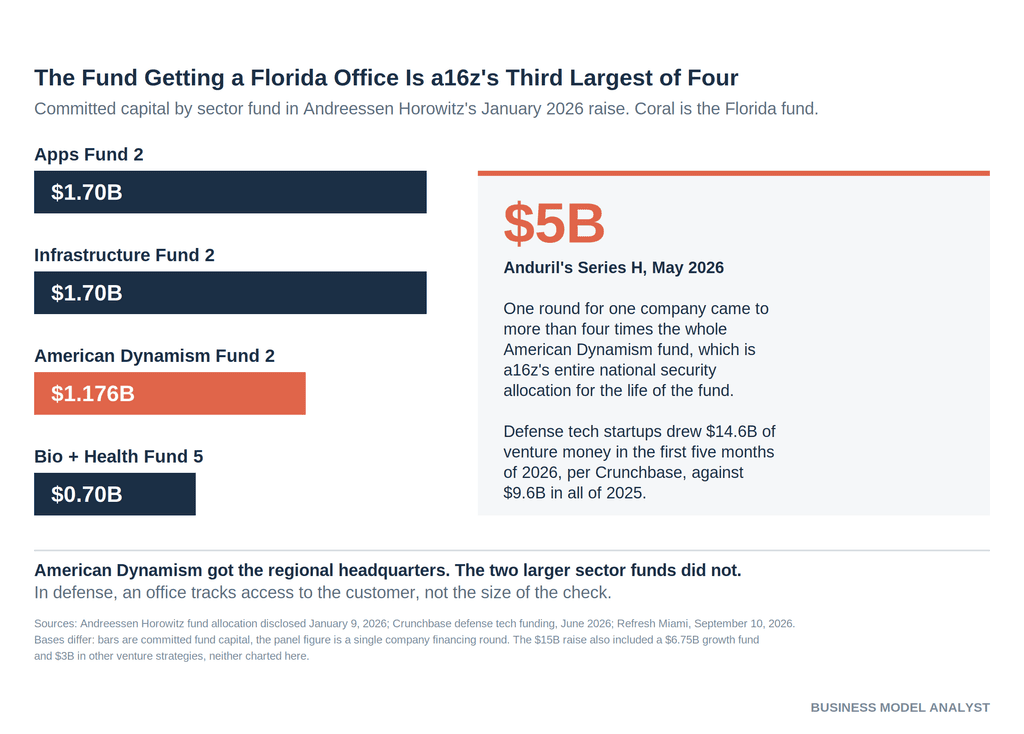
American Dynamism is $1.176 billion, or 7.8% of the $15 billion raise. Anduril’s Series H in May 2026 was $5 billion. One round, for one company, was more than four times the entire fund that just got its own building. The two larger sector funds, Apps and Infrastructure at $1.7 billion each, did not get one.
Now the category. Crunchbase counted more than $14.6 billion of venture money into military, national security and law enforcement startups in the first five months of 2026, against $9.6 billion for all of 2025 and roughly $3 billion in 2024. Deal counts barely moved: 107 rounds through May, against 206 in all of 2025. Run those together and the average round went from about $47 million in 2025 to about $136 million so far in 2026, nearly tripling while the number of companies getting funded stayed flat.
At that average, the whole American Dynamism fund is worth roughly nine rounds. Funds deploy over years and rarely write an entire round, so treat that as an order of magnitude rather than a plan. The direction is what matters: in a category where checks are inflating faster than the company count, a $1.176 billion fund cannot win on price. It has to win on arriving first.
That reframes the office entirely.
- The customer is the scarce input, not the engineer. When one buyer sets the terms, proximity to that buyer is the sourcing advantage. It is the same shape we found in AI infrastructure, where SB Energy handed OpenAI equity worth most of its targeted raise just to get an anchor tenant signed. The scarce thing was never the capacity. It was the counterparty.
- An office is origination spend, not overhead. A few million dollars of Class AA lease against a $1.176 billion fund is a rounding error, and it buys weekly presence at the summits, the accelerator and the base towns. Venture firms have always paid for deal flow through brand and events. This is the same purchase, capitalized into real estate.
- The landlord is the cleanest picks-and-shovels position here. Related Ross owns the tower, convenes the conferences, seeds the accelerator and now hosts the anchor investor. Whatever happens to any single portfolio company, the rent is contracted and the tenant roster just got a marquee name.
- The government is quietly underwriting the funnel. Nearly $23 million of state money into the industrial base, plus a state finance authority marketing cost-of-capital relief, plus a university doubling a defense-focused graduate campus. That is public money building the pipeline a private fund will fish in, the same tension we walked through in who ends up paying for the AI power buildout.
The Risk
The clearest risk is that this exact firm has run this exact play in this exact state and shut it down.
The Miami crypto office followed a thematic fund into a geography during a boom, and closed when the boom ended. Defense tech is in a documented boom. If the office follows the fund and the fund follows the cycle, then the office is a cyclical asset dressed as a commitment.
Concentration is the second problem. Defense-tech returns hinge on a small number of programs of record, and the Pentagon has been consolidating rather than spreading. Anduril’s Army enterprise vehicle folded more than 120 separate procurements into one agreement with a ceiling reported near $20 billion. Palantir signed a comparable arrangement worth up to $10 billion covering about 75 contracts. That is excellent if your portfolio holds one of those names and difficult if it does not, and no amount of geographic proximity changes which side you land on.
Third, proximity decays. Anyone can fly to Tampa. What an office buys is speed and repetition in a relationship, which is real but not defensible. There is no patent on being nearby, and if the thesis works, every rival firm rents the floor above.
Fourth, the founders still have to show up. Florida’s startup base is thin today. If it stays thin, the West Palm Beach office is an expensive conference booth with a view.
The Counterargument
The strongest case for the move is that defense is genuinely a relationship business and the map has already changed underneath the old rule.
Procurement cycles run long, program managers matter more than growth curves, and the people who start defense companies are increasingly ex-operators rather than ex-Stanford. Those founders live near installations. If company formation is migrating toward the bases, then a16z is not abandoning talent, it is following talent to where talent now lives.
The financial case holds up too. No state income tax is a live recruiting argument for a fund’s own partners, and Space Florida’s instruments are a real cost-of-capital lever for hardware companies that need launch access and heavy facilities. That is not marketing, it is balance sheet.
And the option pricing is favorable. The lease is trivial against the fund. Being wrong costs a few million dollars and some travel. Missing an emerging cluster costs an entire vintage. Firms should take that trade every time, and the Miami crypto closure is evidence the firm is willing to cut a bad option rather than defend it. Opening cheaply and closing quickly is a feature of the strategy, not a failure of it.
The honest read is that a16z is buying an option on Florida becoming what Southern California already is. That option is cheap and the payoff is asymmetric.
Quick Questions
Is a16z moving its headquarters to Florida? No. This is a regional base for one fund. Menlo Park remains the firm’s home, alongside offices in New York, Washington and elsewhere.
Does the fund size actually constrain anything? It constrains what a16z can lead. At 2026 average round sizes, $1.176 billion covers roughly nine rounds across the fund’s life, so the strategy has to be early entry rather than late-stage price competition.
Does Florida have the startups yet? Not in volume. The Journal says the state’s defense-tech startup count is still small and trails both California hubs. The state has the customers, the installations and the launch infrastructure.
What would prove this reading wrong? A Florida-headquartered defense-tech company raising a round of several hundred million dollars with a16z leading, within roughly two years of the office opening. That would show origination, not just presence. The counter-signal is equally clean: the office quietly closing, as the Miami one did.
The Business Model Analyst Take
Every venture map ever drawn put the money next to the supply of builders. Florida is the first serious test of putting it next to the demand instead, and the reason is that in national security there is essentially one demand, it owns 21 installations in one state, and it will never move.
The second thing in this story is smaller and more interesting. Nobody in West Palm Beach waited for an ecosystem to emerge. A developer built the conference, backed the accelerator, recruited the university, owned the tower, and then went and got the anchor tenant. That is not a tech cluster forming. That is a real estate product being sold, and the buyer paid in rent.
The fund is roughly 1.1% of what Florida’s defense economy already produces in a year. a16z is not building that industry. It is renting a desk next to it, which is exactly what you do when the thing you cannot manufacture is a phone call that gets returned.
Watch the lease term. In defense, that is the only number that tells you whether anyone actually believes it.